Showing posts with label 1600s. Show all posts

Sunday, November 21, 2010

Mrs. Mary Brewster


Birth: About 1569 in England

Death: 17 April 1627 in Plymouth, Massachusetts, New England

Mary, the wife of William Brewster, was born around the year 1569 in England, possibly Yorkshire or Nottinghamshire. Her maiden name and parentage are unknown though a list of speculative maiden names include Love, Wentworth and Wyrral.

Probably around 1592, Mary married William, likely in the place where they both resided at the time, Scrooby, Nottinghamshire, England. The could had six children: Jonathan, Patience, Fear, An Unnamed Infant, Love, and Wrestling.

Mary emigrated to Holland with her husband and children when the persecution became too harsh in England. Soon, the Separatists were no longer safe in the Netherlands so the plan was hatched that settlers would be sent to America to develop a colony that would benefit England economically and the allow the Separatists to live in peace.

In 1620, Mary, William and two of their sons boarded the Mayflower. William Bradford recorded:

“The names of those which came over first, in the year 1620, and were by the blessing of God the first beginners and in a sort the foundation of all the Plantations and Colonies in New England; and their families...
"Mr. William Brewster, Mary, his wife, with two sons, whose names were Love and Wrestling. And a boy was put to him called Richard More, and another of his brothers. The rest of his children were left behind and came over afterwards.”
William Bradford, Of Plymouth Plantation 1620-1647, ed.

By the fall of 1621, most of the adult women who had traveled on the Mayflower, had died. Mary was one of the only four that survived. However, a few years later in 1627 she died.

She did live long enough to see her older children immigrated and settled in the New World, allowing her to be with all of her living, immediate family members before she died.

Friday, November 19, 2010

John Tilly


Birth: 1571 in Henlow, Bedford, England

Death: During the Winter of 1620-1621 in Plymouth, Massachusetts

John Tilly was the son of Robert and Elizabeth Tilly. He was baptized on 19 November 1571 in England. He was raised with his four sisters and three brothers.

On 20 September 1596, John married Joan Hurst. Together the couple had five children: Rose Tilly (died as a child), John Tilly, Rose Tilly, Robert Tilly and Elizabeth Tilly.

In 1620, John boarded the Mayflower with his wife and youngest daughter, Elizabeth. Upon their arrival to America, John Tilly became a signer of the Mayflower Compact and a witness to the “First Contact” with the Native Americans in their area.

Tilley Family Passenger Record 

The first winter in Plymouth was brutal, killing many of the pilgrims. John and his wife were among those that died. William Bradford wrote:

“Edward Tillie, and his wife both dyed soon after their arrivall; and the girle Humility their cousen, was sent for unto Ento England, and dyed ther But the youth Henery Sampson, is still liveing, and is maried, & hath .7. children. John Tilley and his wife both dyed, a litle after they came ashore; and their daughter Elizabeth maried with John Howland and hath Isue as is before noted.”

This left their daughter Elizabeth an orphan in the New World.

John and Elizabeth’s probable burial site is recognized with this monument at Cole’s Hill, Massachusetts, where their names are listed with other Mayflower passengers that died.

Thursday, November 18, 2010

Elizabeth Tilley


Birth: 1607 in Henlow, Bedfordshire, England

Death: 21 December 1687 in Swansea, Massachusetts, New England

Elizabeth was the daughter of John Tilley and Joan Hurst. She was baptized on 30 August 1607.

Tilley

In 1620, she and her parents boarded the Mayflower (see section of passenger list above) and headed to the New World, leaving behind her four older siblings. In New England, tragedy struck the first winter that the family was living there and Elizabeth lost both of her parents, making her an orphan at only thirteen years old.

Around 1625, while she was still a teenager, she married her fellow Mayflower passenger, John Howland. Together, John and Elizabeth had ten children: Desire, John, Hope, Elizabeth, Lydia, Hannah, Joseph, Jabez, Ruth, and Isaac.

On 21 December 1687, Elizabeth died, leaving behind this will:

“In ye Name of God Amen I Elizabeth Howland of Swanzey in ye County of Bristoll in ye Collony of Plymouth in New Engld being Seventy nine yeares of Age but of good & perfect memory thanks be to Allmighty God & calling to Remembrance ye uncertain Estate of this transitory Life & that all fflesh must Yeild unto Death when it shall please God to call Doe make constitute & ordaine & Declare This my last Will & Testament, in manner & forme following Revoking and Anulling by these prsents all & every Testamt & Testamts Will & Wills heretofore by me made & declared either by Word or Writing And this to be taken only for my last Will & Testament & none other. And first being penitent & sorry from ye bottom of my heart for all my sinns past most humbly desiring forgivenesse for ye same I give & Committ my soule unto Allmighty God my Savior & redeemer in whome & by ye meritts of Jesus Christ I trust & believe assuredly to be saved & to have full remission & forgivenesse of all my sins & that my Soule wt my Body at the generall Day of Resurrection shall rise againe wt Joy & through ye meritts of Christs Death & passion possesse & inheritt ye Kingdome of heaven prepared for his Elect & Chosen & my Body to be buryed in such place where it shall please my Executrs hereafter named to appoint And now for ye settling my temporall Estate & such goodes Chattells & Debts as it hath pleased God far above my Deserts to bestow upon me I Do Dispose order & give ye same in manner & forme following (That is to say) First that after my funerall Expences & Debts paid wc I owe either of right or in Conscience to any manner of person or persons whatsoever in Convenient tyme after my Decease by my Execrs hereafter named I Give & bequeath unto my Eldest Son John Howland ye sum of five pounds to be paid out of my Estate & my Booke called Mr Tindale's Workes & also one pair of sheetes & one pr of pillowbeeres & one pr of Bedblanketts, Item I give unto my son Joseph Howland my Stillyards & also one pr of sheetes & one pr of pillobeeres Item I give unto my son Jabez Howland my ffetherbed & boulster yt is in his Custody & also one Rugg & two Blanketts yt belongeth to ye said Bed & also my great Iron pott & potthookes Item I give unto my son Isaack Howland my Booke called Willson on ye Romanes & one pr of sheetes & one paire of pillowbeeres & also my great Brasse Kettle already in his possession Item I give unto my Son in Law Mr James Browne my great Bible Item I give & bequeath unto my Daughter Lidia Browne my best ffeatherbed & Boulster two pillowes & three Blanketts & a green Rugg & my small Cupboard one pr of AndyIrons & my lesser brasse Kettle & my small Bible & my booke of mr Robbinsons Workes called Observations Divine & Morrall & allso my finest pr of Sheetes & my holland pillowbeeres, Item I give unto my Daughter Elisabeth Dickenson one pr of Sheetes & one pr of pillowbeeres & one Chest Item I give unto my Daughter Hannah Bosworth one pr of sheets & one pr of pillowbeeres, Item I give unto my Grand Daughter Elizabeth Bursley one paire of sheets and one paire of Pillowbeeres Item I give & bequeath unto my Grandson Nathaniel Howland (the son of Joseph Howland) and to the heires of his owne Body lawfully begotten for ever all that my Lott of Land with ye Meadow thereunto adjoyning & belonging lying in the Township of Duxbury neare Jones River bridge, Item I give unto my Grandson James Browne One Iron barr and on Iron Trammell now in his possession, Item I give unto my Grandson Jabez Browne one Chest Item I give unto my Grand Daughter Dorothy Browne my best Chest & my Warming pan Item I give unto my Grand Daughter Desire Cushman four Sheep, Item I give & bequeath my wearing clothes linnen and Woollen and all the rest of my Estate in mony Debts linnen or of what kind or nature or sort soever it may be unto my three Daughters Elisabeth Dickenson, Lidia Browne and Hannah Bosworth to be equally Devided amongst them, Item I make constitute and ordaine my loving Son in Law James Browne and my loving son Jabez Howland Executors of this my last Will and Testament, Item it is my Will & Charge to all my Children that they walke in ye Feare of ye Lord, and in Love and peace towards each other and endeavour the true performance of this my last Will & Testament In Witnesse whereof I the said Elizabeth Howland have hereunto sett my hand & seale this seventeenth Day of December Anno Dm one thousand six hundred Eighty & six.

The mark of Elisabeth E H Howland
Signed Sealed & Delivd
in ye prsence of us Wittnesses
Hugh Cole
Samuel Vyall
John Browne”

Elizabeth and John left a large number of posterity which continues to grow rapidly to this day.

Memorial Inscription

John Howland


Birth: Between 1590 and 1599 in Fenstanton, Huntingdonshire, England

Death: February 1672 or 1673 in Rocky Nook, Kingston, Massachusetts

John Howland was born toward the end of the sixteenth century. The exact year is not known, but it is likely that he was in his early twenties in 1620. John was the son of Henry and Margret Howland. While many in his family were Quakers, John was a member of the Puritan faith.

In 1620, he boarded the Mayflower as the servant of Governor John Carver, another Mayflower passenger, whom he had been working with for some time. Azel Ames wrote in “The Mayflower and Her Log” that:

“John Howland was clearly a ‘secretary’ or ‘steward,’ rather than a ‘servant,’ and a man of standing and influence from the outset.”

En route to the New World, John Howland was swept overboard. Luckily, he was able to grab hold of some rope, which his shipmates then used to pull him back onto the boat. William Bradford writes of this event:

“In sundry of these storms the winds were so fierce and the seas so high, as they could not bear a knot of sail, but were forced to hull [lay-to] for divers days together. And in one of them, as they thus lay at hull in a mighty storm, a lusty young man called John Howland, coming upon some occasion above the gratings was, with a seele [roll] of the ship, thrown into sea; but it pleased God that he caught hold of the topsail halyards which hung overboard and ran out at length. Yet he held his hold (though he was sundry fathoms under water) till he was hauled up by the same rope to the brim of the water, and then with a boat hook and other means got into the ship again and his life saved. And though he was something ill with it, yet he lived many years after and became a profitable member both in church and commonwealth.”
William Bradford, Of Plymouth Plantation 1620-1647, ed.

Painting Depicting John Howland Overboard

John Howland signed the Mayflower compact, and even helped explore the coast of Cape Cod before the final unloading of the boat.

In 1621, John carver died, making John Howland a free man.

In 1624, John married his fellow Mayflower passenger, Elizabeth Tilley. Together, they had ten children: Desire, John, Hope, Elizabeth, Lydia, Hannah, Joseph, Jabez, Ruth, and Isaac.

The lives of John and his family were well documented. To read some of the records relating to them, visit the link below:

http://www.pilgrimhall.org/howlandjohnrecords.htm

John died in the 1670s leaving the following will:

“The Last Will and Testament of mr John howland of Plymouth late Deceased, exhibited to the Court held att Plymouth the fift Day of March Anno Dom 1672 on the oathes of mr Samuell ffuller and mr William Crow as followeth

Know all men to whom these prsents shall Come That I John howland senir of the Towne of New Plymouth in the Collonie of New Plymouth in New England in America, this twenty ninth Day of May one thousand six hundred seaventy and two being of whole mind, and in Good and prfect memory and Remembrance praised be God; being now Grown aged; haveing many Infeirmities of body upon mee; and not Knowing how soon God will call mee out of this world, Doe make and ordaine these prsents to be my Testament Containing herein my last Will in manor and forme following;

Imp I Will and bequeath my body to the Dust and my soule to God that Gave it in hopes of a Joyfull Resurrection unto Glory; and as Concerning my temporall estate, I Dispose thereof as followeth;

Item I Doe give and bequeath unto John howland my eldest sonne besides what lands I have alreddy given him, all my Right and Interest To that one hundred acres of land graunted mee by the Court lying on the eastern side of Tauton River; between Teticutt and Taunton bounds and all the appurtenances and privilidges Therunto belonging, T belonge to him and his heirs and assignes for ever; and if that Tract should faile, then to have all my Right title and Interest by and in that Last Court graunt to mee in any other place, To belonge to him his heires and assignes for ever;

Item I give and bequeath unto my son Jabez howland all those my upland and Meadow That I now posesse at Satuckett and Pamet, and places adjacent, with all the appurtenances and privilidges, belonging therunto, and all my right title and Interest therin, To belonge to him his heires and assignes for ever,

Item I Give and bequeath unto my son Jabez howland all that my one peece of land that I have lying on the southsyde of the Mill brooke, in the Towne of Plymouth aforsaid; be it more or lesse; and is on the Northsyde of a feild that is now Gyles Rickards senir To belonge to the said Jabez his heirs and assignes for ever;

Item I give and bequeath unto Isacke howland my youngest sonne all those my uplands and meddows Devided and undivided with all the appurtenances and priviliges unto them belonging, lying and being in the Towne of Middlebery, and in a tract of Land Called the Majors Purchase near Namassakett Ponds; which I have bought and purchased of William White of Marshfeild in the Collonie of New Plymouth; which may or shall appeer by any Deed or writinges Together with the aformentioned prticulares To belonge to the said Isacke his heirs and assignes for ever;

Item I give and bequeath unto my said son Isacke howland the one halfe of my twelve acree lott of Meddow That I now have att Winnatucsett River within the Towne of Plymouth aforsaid To belonge to him and said Isacke howland his heires and assignes for ever;

Item I Will and bequeath unto my Deare and loveing wife Elizabeth howland the use and benifitt of my now Dwelling house in Rockey nooke in the Township of Plymouth aforsaid, with the outhousing lands, That is uplands uplands [sic] and meddow lands and all appurtenances and privilidges therunto belonging in the Towne of Plymouth and all other Lands housing and meddowes that I have in the said Towne of Plymouth excepting what meddow and upland I have before given To my sonnes Jabez and Isacke howland During her naturall life to Injoy make use of and Improve for her benifitt and Comfort;

Item I give and bequeath unto my son Joseph howland after the Decease of my loveing wife Elizabeth howland my aforsaid Dwelling house att Rockey nooke together with all the outhousing uplands and Medowes appurtenances and privilidges belonging therunto; and all other housing uplands and meddowes appurtenances and privilidges That I have within the aforsaid Towne of New Plymouth excepting what lands and meadowes I have before Given To my two sonnes Jabez and Isacke; To belong to him the said Joseph howland To him and his heires and assignes for ever;

Item I give and bequeath unto my Daughter Desire Gorum twenty shillings

Item I give and bequeath To my Daughter hope Chipman twenty shillings

Item I give and bequeath unto my Daughter Elizabeth Dickenson twenty shillings

Item I give and bequeath unto my Daughter Lydia Browne twenty shillings

Item I give & bequeath to my Daughter hannah Bosworth twenty shillings

Item I give and bequeath unto my Daughter Ruth Cushman twenty shillings

Item I give to my Grandchild Elizabeth howland The Daughter of my son John howland twenty shillings

Item my will is That these legacyes Given to my Daughters, be payed by my exequitrix in such species as shee thinketh meet;

Item I will and bequeath unto my loveing wife Elizabeth howland, my Debts and legacyes being first payed my whole estate: vis: lands houses goods Chattles; or any thing else that belongeth or appertaineth unto mee, undisposed of be it either in Plymouth Duxburrow or Middlbery or any other place whatsoever; I Doe freely and absolutly give and bequeath it all to my Deare and loveing wife Elizabeth howland whom I Doe by these prsents, make ordaine and Constitute to be the sole exequitrix of this my Last will and Testament to see the same truely and faithfully prformed according to the tenour therof; In witness whereof I the said John howland senir have heerunto sett my hand and seale the aforsaid twenty ninth Day of May, one thousand six hundred seaventy and two 1672

Signed and sealed in the
prsence of Samuel ffuller John Howland
William Crow And a seale”

John Howland outlived all other Mayflower passengers, except one, in New England and he and Elizabeth together have one of the largest groups of progeny for the Mayflower passengers. He was remembered well by those he knew, one of which recorded this upon his death:

“The 23th of February, 1672/3, Mr John Howland, Seni'r, of the towne of Plymouth, deceased. Hee was a godly man and an ancient professor in the wayes of Christ ; hee liued vntill hee attained aboue eighty yeares in the world. Hee was one of the first comers into this land, and proued a vsefull instrument of good in his place, & was the last man that was left of those that came ouer in the shipp called the May Flower, that liued in Plymouth ; hee was with honor intered att the towne of Plymouth on the 25 of February, 1672/3.”
Plymouth Colony Records, Vol. 8, p. 34.
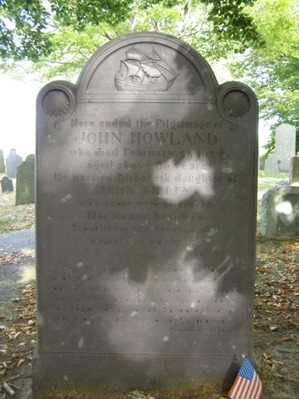
 John Howland's Memorial Headstone

Wednesday, November 17, 2010

William Brewster


Birth: Between 1566 and 1567 in Scrooby, England

Death: Between 1633 and 1644 in Plymouth, New England

Willam Brewster was the son of William and Mary Brewster, born around 1566. He was raised by his father and step mother, Prudence Peck, and had a number of half-siblings.

William was well educated and attended Cambridge University for some time, but left without obtaining a degree.

Upon leaving Cambridge, William began to work his way through the ranks of government. In 1583 he was employed by William Davidson and the Court of England. William Brewster worked with William Davidson as liaisons between Queen Elizabeth of England and Mary Queen of Scots. However, after the execution of Mary, William Brewster returned home where he managed his family’s mansion.

By 1593, William had married Mary (possibly Wentworth). The couple had six children together: Jonathan Brewster, Patience Brewster, Fear Brewster, Love Brewster, Wrestling Brewster and an unnamed baby that died not long after its birth.

After returning home, Brewster started a Separatist church, inspired by the churches he saw in the Netherlands while serving the queen. His partner was Richard Clyfton.

As government pressure increased for Separatist churches like the William Brewster’s, the group planned to see refuge in Holland. In 1608, the group finally managed to make it Amsterdam, a year later settling in Leiden, Holland.


The group lived in Leiden for about ten years, with pressures from the Dutch and English governments growing all the while. It was during this time that they began considering a move to America where they could develop a colony of their own. In 1620, William, some of his family and a small portion of their congregation boarded the Mayflower and began heading towards the New World. William Bradford recounts:


“Those that stayed [in Leyden], being the greater number, required the pastor [John Robinson] to stay with them; and indeed for other reasons he could not then well go, and so it was the more easily yielded unto. The other [Pilgrims leaving Leyden] then desired the elder, Mr. Brewster, to go with them, which was also condescended unto. It was also agreed on by mutual consent and covenant that those that went should be an absolute church of themselves, as well as those that stayed, seeing in such a dangerous voyage, and a removal to such a distance, it might come to pass they should (for the body of them) never meet again in this world.”
William Bradford, Of Plymouth Plantation 1620-1647, ed.

In Plymouth, William continued his role as an Elder. He served as the only religious leader for nine years and continued preaching until his death. He was granted land in Duxbury and Boston Harbor (islands). He also signed the Mayflower Compact. Below is the copy found in William Bradford’s journal.

Mayflower Compact

William Brewster is well remembered in Pilgrim history. He is often included in pieces of art depicting the arrival of the Mayflower in Plymouth and the first Thanksgiving. He is also well documented in Plymouth records and in the writings of William Bradford. To read some of these documents visit the website below:

http://www.pilgrimhall.org/brewsterwilliamrecords.htm

William Brewster's Memorial

George Soule


Birth: Between 1590 and 1600 in England

Death: 1679 in Duxbury, Plymouth, Massachusetts, America

George Soule was born in England at the end of the sixteenth century. There is much speculation as to who his parents were, but nothing definitive has yet been determined.

He worked in the home of Edward and Elizabeth Winslow as a teacher to the couple’s children. He was still a young man when the entire family set sail on the Mayflower in 1620. William Bradford wrote of the group:

"The names of those which came over first, in the year 1620, and were by the blessing of God the first beginners and in a sort the foundation of all the Plantations and Colonies in New England; and their families ...Mr. Edward Winslow, Elizabeth his wife and two men-servants called George Soule and Elias Story; also a little girl was put to him called Ellen, the sister of Richard More."
William Bradford, Of Plymouth Plantation 1620-1647, ed.

Upon his arrival to the New World, George became one of the signers of the Mayflower Compact.

Mayflower Compact

Between 1625 and 1627, George married Mary Buckett in Plymouth. Together, the couple had nine children:  Zachariah, John, Nathaniel, George, Susanna, Mary, Elizabeth, Patience and Benjamin.

By 1642, the family had moved to Duxbury where George served on a number of committees and survey teams. At one point he was even a deputy to Plymouth Court. Like the other settlers in Massachusetts, the Soule family’s doings were documented in court records and by William Bradford. Many of comments from the records relating to George Soule can be found at this website:

http://www.pilgrimhall.org/soulegeorgerecords.htm

Before his death, George wrote a will, which he added to a month after it was written. The addition protects his daughter Patience from her brother, John. The full text of the will reads:

“In the Name of God Amen

I Gorge Soule senir of Duxberry in the Collonie of New Plymouth in New England being aged and weake of body but of a sound mind and Memory praised be God Doe make this my last Will and Testament in Manor and forme following Imprimis I comitt my soule into the hands of Almighty God whoe Gave it and my body to be Decently buried in the place appointed for that use whensoever hee shall please to take mee hence; and for the Disposall of my outward estate which God of his Goodnes hath Given mee first I have and alreddy formerly by Deeds under my hand and seale Given unto my two sonnes Nathaniel: and Gorge All my lands in the Township of Dartmouth; Item I have formerly Given unto my Daughters Elizabeth and Patience all my lands in the Township of Middleberry Item I Give and bequeath unto my Daughters Sussannah and Mary twelve pence a peece to be payed by my executer heerafter Named after my Decease; And forasmuch as my Eldest son John Soule and his family hath in my extreame old age and weaknes bin tender and carefull of mee and very healpfull to mee; and is likely soe to be while it shall please God to continew my life heer therfore I give and bequeath unto my said son John Soule all the Remainder of my housing and lands whatsoever to him his heires and Assignes for ever Item I Give and bequeath unto my son John Soule all my Goods And Chattles whatsoever Item I Nominate And appoint my son John Soule to be my sole Executor of this my last Will and Testament; and lastly I Doe heerby make Null and voyde all other and former wills and Testaments by mee att Any time made; and Declare this Instrument to be my last Will and Testament In Witnes wherof I the said Gorge Soule have heerunto sett my hand and seale this eleventh Day of August in the year of our Lord one Thousand six hundred seaventy and seaven;

Gorge Soule and a seale

The above Named Gorge Soule Did signe seale and Deliver this Instrument to be his Last Will and Testament in the prsence of us

Nathaniell Thomas
The Marke D T of Deborah Thomas

Item the twentyeth Day of September 1677 I the above Named Gorge Soule Doe heerby further Declare that it is my will that if my son John Soule above named or his heires or Assignes or any of them shall att any time Disturbe my Daughter Patience or her heires or Assignes or any of them in peacable Posession or Injoyment of the lands I have Given her att Namassakett allies Middleberry and Recover the same from her or her heires or Assignes or any of them That then my Gift to my son John Soule shall shalbe voyd; and that then my will is my Daughter Patience shall have all my lands att Duxburrey And she shalbe my sole executrix of this my last Will and Testament And enter into my housing lands and meddowes att Duxburrow, In Witnes wherof I have heerunto sett my hande and seale;

Gorge Soule and A seal

The above Named George Soule Did Signe and seale to this addition in the prsence of us Nathaniel Thomas

The Marke D T of Deborah Thomas”

A full list of George Soule’s belongings and estate can be seen at:

http://www.pilgrimhall.org/willgsoule.htm

George Soule died in 1679 or 16980 in Plymouth (also spelled Plimoth and Plimouth, throughout history).

Tuesday, July 27, 2010

Mrs. Susanna Pulsipher


Birth: 1691 in Boston, Massachusetts

Death: After 1727 in Boston, Massachusetts

So little is known about Susanna that even her parents and maiden name remain a mystery. While it is possible that her father may be Francis Loude (born about 1665 in Ipswich, Massachusetts), a firm link has yet to be proved.

She and David Pulsipher married between 1700 and 1710. The couple had six children together, all while living in Boston. They were: David Pulsipher (b. 7 May 1708), Susannah Pulsipher (b. 19 November 1710), Margaret Pulsipher (b. 6 July 1712), Joseph Pulsipher (b. 27 December 1713), Elizabeth Pulsipher (b. 11 February 1717) and Abigail Pulsipher (b. 27 November 1720).

In 1727, Susanna received a license to sell hard drinks in Boston (from “Boston Selectmen’s Minutes, 1716 to 1736”).

Susanna A. Waters


Birth: 1 February 1649 in Salem, Essex, Massachusetts

Death: 21 December 1726 in Ipswich, Essex, Massachusetts

Susanna was born to Richard Waters (1604-1676) and Joyce Plaise (1616-1697), who were both colonists in Salem, Massachusetts from England.

Susanna and Benedict (of whom she was the second wife) were married in Ipswich, Massachusetts around 1673 and had many children together: Richard Pulsipher, William Pulsipher, Susanna Pulsipher (died as a child), Joseph Pulsipher, Jonathan Pulsipher, Johanna Pulsipher (Jonathan’s twin), Susanna Pulsipher, Elizabeth Pulsipher, David Pulsipher and Margret Pulsipher.

Town records have shown that she broke the laws of her town to wear beautiful clothing (silk hoods and scarves) to church. In Puritan settlements this was considered vanity. She was arrested, tried and fined ten schillings.

Monday, July 26, 2010

David Pulsipher


Birth: 27 September 1685 in Ipswich, Essex, Massachusetts

Death: After 1720 in Boston, Middlesex, Massachusetts

David was the son of Benedict (or Benedictus) Pulsipher (1639-1695) and Susanna A. Waters (1649-1726).

He grew up with his farming parents in Colonial Massachusetts, where he eventually met Susanna (whose maiden name is unknown). He and Susanna were married in Salem, Massachusetts between 1695 and 1708.

The couple had six children together, all while living in Boston. They were: David Pulsipher (b. 7 May 1708), Susannah Pulsipher (b. 19 November 1710), Margaret Pulsipher (b. 6 July 1712), Joseph Pulsipher (b. 27 December 1713), Elizabeth Pulsipher (b. 11 February 1717) and Abigail Pulsipher (b. 27 November 1720).

David was sailor in Boston, Massachusetts, likely of merchant vessels.

Wednesday, July 21, 2010

Thomas Dutton


Birth: Between 1619 and 1622 in Dutton, Cheshire, England

Death: 22 January 1687 in Billerica, Massachusetts, America

Thomas Dutton was an English immigrant that settled in the newly founded Massachusetts Bay Colony. His parents were probably John Dutton (5 October 1598-4 May 1693) and Mary Nuld (born about 1599).

He was married in about 1647 to a woman named Susannah (about 1626-27 August 1684) in Billerica, Middlesex, Massachusetts. While Susannah’s maiden name remains unknown, one possibility is that she was Susannah Palmer.

The two had nine children together: Thomas Dutton, Mary Dutton, Susannah Dutton, John Dutton, Elizabeth Dutton, Joseph Dutton, Sarah Dutton, James Dutton and Benjamin Dutton.

Thomas’ presence is made known on several occasions in legal records in Middlesex, Massachusetts. In 1661, he was accused of beating his wife, although he and Susannah both denied the claims. In 1668, Michael Bacon accused Thomas of theft, so Thomas sued him for slander. To free himself of the charges, Thomas obtained signed statements declaring that he had lived in the community for many years and that he was an upstanding man. At another point in time, he had a land dispute with John Carter (one of the men who signed his court statement) in which Thomas lost and had to pay a fine.

After Susannah died in 1684, Thomas married a woman about 32 years his junior named Ruth Hooper.

Via his son Joseph Dutton, Thomas Dutton and Susannah are the 4th great grandparents of Latter-Day Saint prophet, Joseph Smith as well as the 5th great grandparents of prophet Joseph F. Smith and the 6th great grandparents of Joseph Fielding Smith (though Joseph F. and Joseph Fielding are both descended from Joseph Smith’s brother, Hyrum Smith).

Much of this information comes from: “Genealogical Register of First Families of New England” by John Farmer and “Middlesex County, Court Records” volume 1.

Monday, July 19, 2010

Benedict Pulsipher


Birth: About 1639 in England

Death: 10 April 1695 in Massachusetts, America

Benedict (or Benedictus) was the first Pulsipher to arrive in America, and possibly the first “Pulsipher” in the world. While it is suspected that his father was Benjamin Pulsipher (born in about 1614 in Ireland), it is hard to trace the family any further back due to confusions about the name. While it was a mystery for a long time, recent years have suggested that the family was originally the Pulford family, but changed their name upon reaching America (or just before) to escape association with the Puritans in England that had just beheaded Charles I. Additionally, throughout the years, the name has adapted many different spellings (including Pulcipher, Pulsifer, Pulcifer, etc.).

Benedict was married to his second wife, Susanna A. Waters (1 February 1649-21 December 1726) in February of either 1673 or 1674 in Ipswich, Massachusetts, America. His first wife’s name is unknown, but he married her a few years before coming to America.

Benedict and Susanna had several children: Richard Pulsipher, William Pulsipher, Susanna Pulsipher (died as a child), Joseph Pulsipher, Jonathan Pulsipher, Johanna Pulsipher (Jonathan’s twin), Susanna Pulsipher, Elizabeth Pulsipher, David Pulsipher and Margret Pulsipher.

Benedict had other children with his first wife, as well, however their records are not as clear. These children include: Benedict Pulsipher Junior and John Pulsipher.

Benedict was considered well educated for the time.

He lived out the rest of his life as a farmer in the Massachusetts Bay Colony.